
What's the problem anyway?

Palaeontologists throughout history have tried to answer a question: Does evolution make new life modes or intensify a limited set of life modes or strategies of life? A standard testable framework is made by Dr Bambach to measure how different niches/modes of life have been occupied, so we can see whether ecosystems have become more complex through geological time. In order to solve this, the author converts autecology into 3 simple axes, tiering × motility × feeding, with 6 classes on each axis, forming 216 theoretical modes of life. They then plot real taxa into those bins and count which bins are actually used versus what's possible. This works because we can infer function from morphology, a fundamental principle of palaeontology. The authors do this in 4 different intervals: Ediacaran, Early–Middle Cambrian, Late Ordovician, and Recent. This allows us to have a repeatable, comparable metric to measure ecological complexity and test hypotheses about drivers of change by tracking changes or shifts in abundance of modes, not just presence.


Niche
- function and position of organism and how it interacts with its environment
Autecology
- ecology of a particular species
Real taxa
- fossilised species
Function
- different things it could do in the ecosystem
Morphology
- physical/structural feature
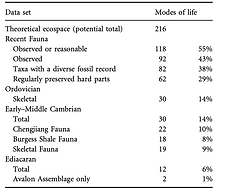
(Bambach et al., 2007)